
Every DTC operator eventually runs into the same wall: a product sells faster than expected, the stock count hits zero, and now there’s a decision to make. Do you stop taking orders, or do you keep selling and promise the customer it’ll ship soon? That second option is a backorder and how well you handle it says a lot about how mature your inventory operation actually is.
DTC brands are under more inventory pressure than ever in 2026. Channel economics have shifted Amazon new seller launches dropped sharply in the past year, and established sellers are seeing thinner margins as fees stack up, which means more brands are leaning harder into their own DTC channels to protect profitability. But DTC growth only holds up if the fulfillment behind it does too. A backorder on your own site doesn’t just delay a shipment it’s a direct hit to the customer relationship you’re trying to build without Amazon in the middle.
What Does Back Order Mean, Exactly?
“Back order” means a customer has successfully purchased a product that isn’t currently in stock, with a committed (if delayed) ship date. It’s not a cancellation, and it’s not a stockout in the sense that no sale happened the sale happened. The inventory just hasn’t caught up yet.
This is worth spelling out because the terms get used loosely. A “stockout” describes the inventory event you’re at zero units. A “backorder” describes what you do about it on the customer-facing side: you keep selling anyway and promise fulfillment later. Every backorder starts with a stockout. Not every stockout becomes a backorder some brands just close the buy button instead.
For a deeper breakdown of how backorders work end to end, see our earlier guide on what is a backorder, which covers the mechanics and how AI forecasting helps prevent them in the first place.
Why Backorders Hit DTC Brands Differently Than Amazon Sellers
That distinction matters more than most brands realize when they’re deciding how to split inventory across channels.
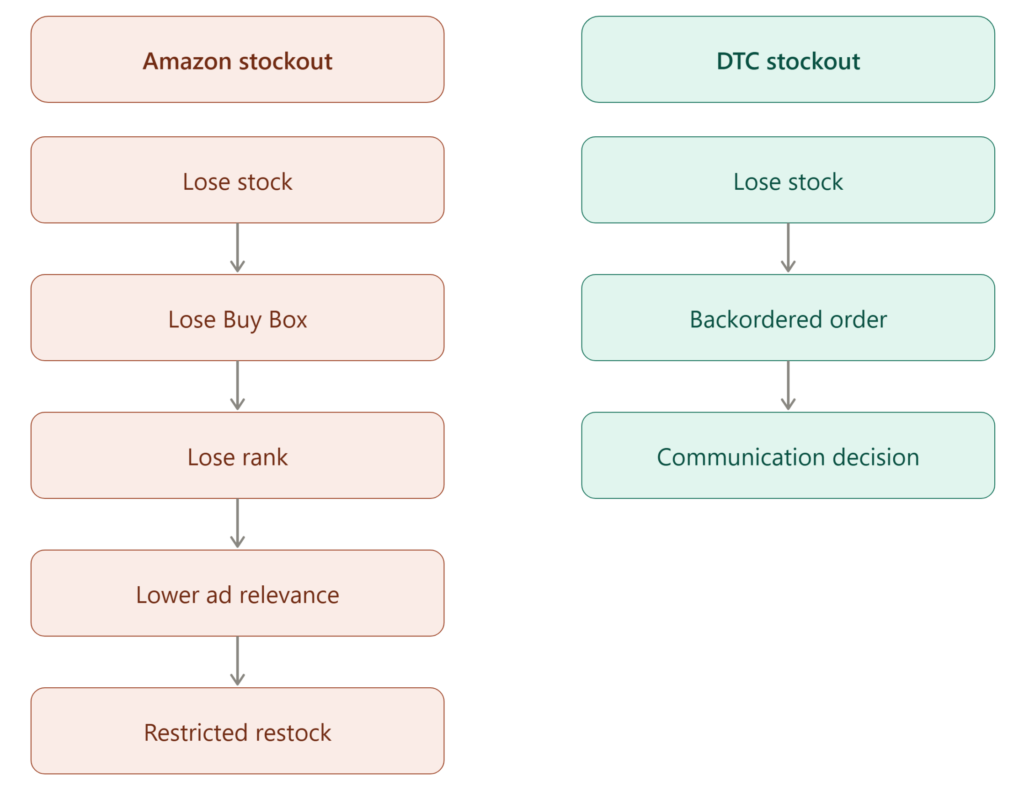
An Amazon stockout compounds in ways that are mostly invisible to the customer but brutal for the seller: lost Buy Box, lower ad relevance, restricted restock limits, a recovery tail that can take weeks even after stock is back. A DTC stockout is simpler and more personal it’s a direct message to a customer who already trusts your brand enough to buy without a marketplace’s safety net. That’s lower operational risk, but higher relationship risk if it happens too often or gets handled badly.
This is exactly why inventory allocation shouldn’t be split evenly across channels by default. The smarter approach and the one more DTC-forward brands are adopting in 2026 is weighting safety stock by what a stockout actually costs on each channel, not assuming Amazon and DTC deserve equal buffers.
The Real Cost of Getting This Wrong
Numbers help make this concrete. Brands relying on simple trailing-average forecasting have been shown to run stockout rates more than double those using weighted or seasonal forecasting methods. On a single mid-size SKU, a two-week stockout has been estimated to cost anywhere from $80,000 to $120,000 in permanently lost forward revenue and that’s before counting the customer trust that doesn’t come back.
The takeaway for DTC-first brands isn’t “avoid backorders at all costs.” It’s “know which SKUs can absorb a backorder gracefully, and which ones can’t.” A slow-moving accessory backordering for a week is a non-event. Your best-selling hero product going backordered during a launch window is a real problem.
How to Handle a Backorder Without Losing the Customer
If a backorder is going to happen anyway, execution is everything. A few things separate brands that keep customers through a backorder from brands that lose them:
1. Be specific, not vague. “Ships in 2-3 weeks” builds more trust than “backordered check back soon.”
2. Communicate before the customer has to ask. Proactive emails outperform reactive customer service every time.
3. Segment by SKU risk. Products prone to repeat backordering deserve tighter inventory buffers than one-off sellers.
4. Fix the root cause, not just the symptom. If a SKU keeps going backordered, that’s a forecasting or pick and pack accuracy problem, not bad luck.
Backorders, Deadstock, and the Balancing Act
Here’s the tension every DTC brand lives with: order too conservatively and you get backorders. Order too aggressively and you end up with deadstock inventory that sits in a warehouse not selling, quietly eating into margin. The “never run out again” overcorrection is a well-documented pattern; brands that got burned by stockouts in past shortage years over-ordered afterward and ended up sitting on excess inventory for the following two years instead.
There isn’t a single right answer here. There’s a right answer per SKU, based on how that specific product actually sells and how forgiving your customers are likely to be if it backorders. That’s a forecasting problem and it’s one AI-assisted demand planning is built specifically to solve.
Key Takeaways
Back order means the sale is confirmed, but shipment is delayed different from a stockout, which is the inventory event that causes it
1. DTC backorders and Amazon stockouts carry very different operational costs, so they shouldn’t get identical inventory buffers
2. Poor forecasting doesn’t just cause backorders it can just as easily cause the opposite problem, deadstock
3. How you communicate a backorder matters as much as preventing it in the first place