
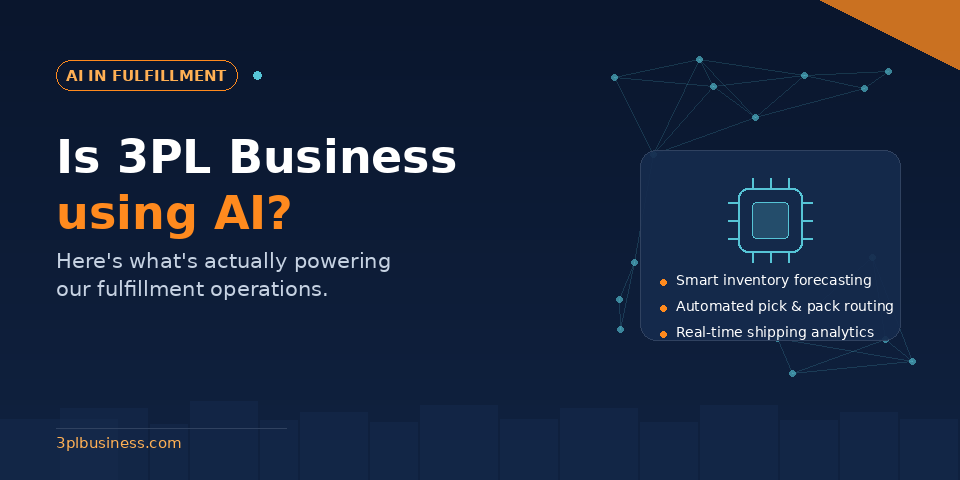
Ask around the logistics industry right now and it feels like every provider claims to be “AI-powered.” Scroll through a few 3PL websites and you’ll see the same buzzwords repeated smart warehouses, predictive everything, AI-driven fulfillment. It’s a lot of noise, and honestly, most of it oversells what’s really happening on the warehouse floor.
We’d rather tell you the truth: some of what we use is genuinely automated and data-driven. Some of it is straightforward software doing a specific job well. And some of the flashier stuff like demand forecasting or AI chatbots isn’t part of our operation yet. Here’s an honest look at the technology behind fulfillment at 3PL Business, and why we think that honesty matters more than a buzzword.
Why This Matters for Ecommerce Brands
If you’re evaluating a fulfillment partner, you’re not just buying warehouse space. You’re trusting someone else to get orders out the door correctly, on time, every time. The technology a 3PL uses (or doesn’t use) directly affects how often your orders ship error-free, how fast they move, and how much visibility you get into what’s happening with your inventory.
So instead of listing vague claims, we broke down exactly what’s running behind the scenes.
Carrier Selection: Choosing the Right Shipping Option Automatically
One place where automation genuinely helps is shipping. Rather than manually comparing rates every time an order goes out, our system automatically selects the best carrier USPS, UPS, FedEx, and others based on cost and delivery speed for that specific shipment. This kind of automated decision-making is a core part of our shipping services, and it’s one of the simplest ways technologies saves both time and money without adding complexity for the customer.
Barcode-Based Inventory Tracking
Every item that comes through our facility is tracked using barcode-based inventory systems. This isn’t glamorous technology, but it’s the backbone of accuracy. Every scan update inventory record in real time, which means fewer misplaced items, fewer overselling situations, and a much clearer picture of what’s actually on the shelf. This directly supports the reliability behind our warehousing services, where accurate stock counts make or break fulfillment speed.
Our tracking also extends to QR codes with an embedded barcode, giving us the ability to monitor expiration dates — especially valuable for food and perishable product brands.
Warehouse Software for Picking, Packing, and Order Processing
Picking and packing errors are one of the most common (and most avoidable) problems in fulfillment. We rely on dedicated warehouse software to guide the picking process, sequence orders efficiently, and reduce the manual guesswork that leads to mistakes. Combined with wearable barcode scanners that our warehouse team uses on the floor, this keeps pick & pack fulfillment accurate even as order volume increases.
The same systems support more specialized processes too, including kitting & assembly, where multiple SKUs need to come together correctly into a single finished unit before it ships.
Route Optimization for Deliveries
On the outbound side, route optimization software helps plan more efficient delivery paths, which matters both for speed and for keeping shipping costs predictable. It’s a smaller piece of the puzzle compared to picking or inventory tracking, but it adds up, especially for brands shipping high volumes across multiple regions.
Automated Conveyor and Sorting Systems
This is where warehouse automation is the most visible. Automated conveyor and sorting systems move products through the facility, reducing manual handling and speeding up how quickly orders get from the shelf to the shipping dock. For high-volume operations, this kind of equipment isn’t optional anymore it’s what allows a warehouse to scale without a proportional increase in labor and errors.
Warehouse Control Systems and Internal Dashboards
Behind the scenes, our warehouse control systems coordinate the automated equipment, scanners, and picking workflows so everything works together instead of as disconnected pieces. We also use internal dashboards to monitor warehouse performance and shipping activity. These dashboards are used by our operations team to catch issues early they’re not a customer-facing feature, but they directly influence how consistently orders go out correctly.
The Bigger Picture: Technology Should Support the Work, Not Replace the Explanation
None of this technology works in isolation. Barcode scanning feeds into warehouse control systems. Warehouse software coordinates with automated conveyors. Route optimization connects to carrier selection. Together, these tools are what let us support brands using ecommerce fulfillment services across Shopify, Amazon, Walmart, Tiktok and direct-to-consumer channels, including specialized needs like Amazon FBA prep.
What we won’t do is dress up basic automation as artificial intelligence just because it sounds more impressive. If you’re comparing fulfillment partners, ask specific questions about what’s actually running their operations. It’s a better way to judge fit than any buzzword on a homepage.
If you want to know more about how our systems would handle your specific order volume or sales channels, reach out to our team and we’ll walk you through it honestly.
FAQs
What technology does 3PL Business use for fulfillment?
3PL Business uses automated carrier selection, barcode-based inventory tracking, warehouse picking and packing software, route optimization, automated conveyor and sorting systems, and warehouse control systems to keep orders accurate and moving efficiently.
How does 3PL Business choose which shipping carrier to use?
Our system automatically compares available carriers, including USPS, UPS, and FedEx, and selects the option that best balances cost and delivery speed for each shipment.
What technology keeps inventory accurate?
Barcode-based tracking updates inventory records in real time as items are scanned, which reduces errors like overselling or misplaced stock.
Is warehouse automation used at our facilities?
Yes. Automated conveyor and sorting systems are used to move products through the warehouse, reducing manual handling and speeding up order processing.
Does we use warehouse management software?
Of course! Dedicated warehouse software guides picking, packing, and order processing, while warehouse control systems coordinate that software with scanners and automated equipment on the floor.