
Few things frustrate an online shopper faster than opening a box and finding the wrong item inside. For the brand it’s worse: a replacement shipment, a return label, a support ticket, and a customer who may not order again. One wrong-size sweater looks like a small slip, but across hundreds of orders a week the cost adds up.
Answer: Order accuracy is the percentage of orders shipped with the right items, quantities and packaging. The most reliable way to improve it is to verify at every step. Scan barcodes at receiving, picking and packing, give every SKU one clean location, and track errors by cause so you fix the process instead of blaming the picker.
How to measure order accuracy
The formula is simple:
Order accuracy = (orders shipped without error ÷ total orders shipped) × 100
If you ship 2,000 orders and 30 have an error, your accuracy is 98.5%. That sounds fine until you realize it means 30 customers got the wrong experience. Many fulfillment operations aim for 99% or higher, but the right target depends on your product mix. Start by benchmarking your own numbers.
Why picking errors happen
Most errors come from the setup, not from careless people. The usual causes are:
1. Similar SKUs, such as sizes or colors of the same product, stored side by side
2. Paper pick lists or picking from memory
3. Poorly labeled bins, or mixed products in one location
4. Inventory records that don’t match what’s on the shelf
5. Rushed packing as the daily shipping cutoff approaches
Five practical ways to reduce picking errors
1. Scan at every step. Barcode scanning at receiving, picking and packing means the system flags a wrong item before it leaves the building. A picker who grabs a medium instead of a large gets an error on the scanner instead of a complaint from the customer.
2. Give every SKU one clean home. Use clear bin labels, keep one product per location, and separate look-alike items. This matters a lot for apparel and variant-heavy catalogs. What layout of designs in a retail store do not work well in a fulfilment center.
3.Match the pick method to your orders. Single-item orders can be batch picked. Larger multi-line orders often work better with zone or wave picking. The wrong method creates extra walking, extra handling and more chances for mistakes.
4. Add a check at packing. A second scan or visual check against the order catches what the pick step missed. It takes seconds and prevents most “missing item” claims.
5. Track errors by root cause. Log every mistake as a wrong SKU, wrong quantity, missing item, or damaged item, and note where it happened. Patterns show up quickly. If one shelf causes half your errors, you’ve found your fix. Regular cycle counts keep inventory data honest too.
Here’s where each scan checkpoint catches an error before it reaches the customer.
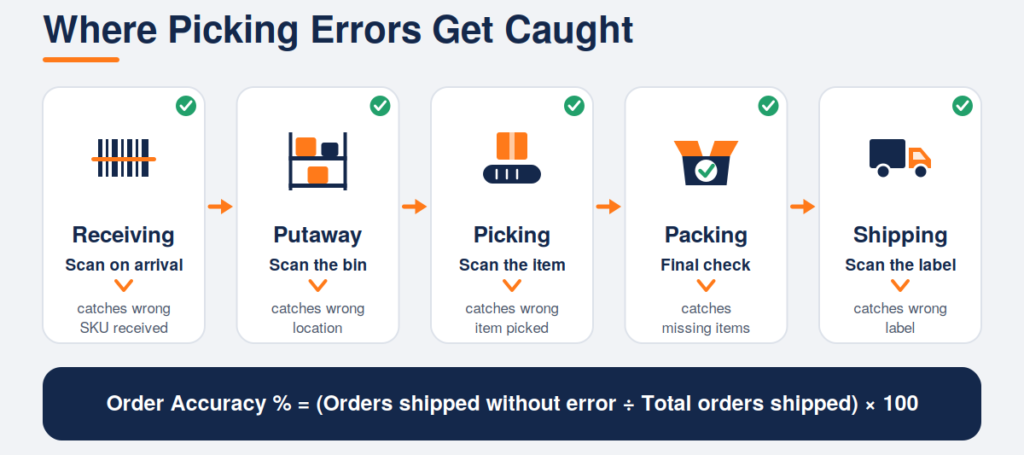
1. Receiving: scan on arrival to catch a wrong SKU received
2. Put away: scan the bin to catch a wrong location
3. Picking: scan the item to catch a wrong item picked
4. Packing: final check to catch missing items
5. Shipping: scan the label to catch a wrong label
Don’t forget multi-piece orders
Orders with several items or cartons are where accuracy slips most. Every extra piece is another chance for something to be left behind or split into the wrong box. Use order-level verification so the order can’t close until every item is scanned, and label multi-carton shipments clearly so they stay together in transit.
What to ask a 3PL about accuracy
If you’re thinking about outsourcing, don’t settle for “we’re very accurate.” Ask:
1. Do you scan at receiving, picking and packing?
2. How do you measure and report order accuracy?
3. How do you handle multi-item orders and kits?
4. How often do you run cycle counts?
5. How do you sync inventory with Shopify, Amazon or ShipStation?
6. A good provider will answer with specifics and numbers.
Putting it into practice
Better accuracy comes from process, not heroics: scanning, tidy SKU locations, a packing check, and honest error tracking. You can build this in-house, but it takes time, equipment and software many growing brands would rather not manage. That’s where a fulfillment partner helps. 3PL Business’s pick and pack and ecommerce fulfillment services are built around these checks, with integrations like Shopify and ShipStation keeping orders and inventory in sync.If wrong or missing items are costing you customers, schedule a free consultation and we’ll look at where your errors are coming from.
FAQ’s
What is a good order accuracy rate for ecommerce fulfillment?
Many fulfillment operations aim for 99% or higher, but the right target depends on your products and order mix. Track your own rate first, then set a target you can improve step by step.
How do you calculate order accuracy?
Divide the orders shipped without error by the total orders shipped, then multiply by 100. For example, 1,970 error-free orders out of 2,000 gives 98.5%.
What causes picking errors in a warehouse?
The most common causes are similar-looking SKUs stored together, manual or paper-based picking, poorly labelled bins, inaccurate inventory records, and rushed packing near the shipping cutoff.
How do 3PLs reduce picking errors?
Most use barcode scanning at receiving, picking and packing, along with organized bin locations, a final check before shipping, and regular cycle counts. Ask any 3PL you’re considering to explain its checks in detail.
How can I prevent missing items in multi-item orders?
Use order-level verification so the order can’t close until every item is scanned, and pre-assemble bundles or kits where you can. Label multi-carton shipments clearly so the cartons stay together.