
Most people ordering online don’t think twice about how their package gets from a warehouse shelf to their doorstep. They click “buy,” and a few days later it shows up. Clean, simple.
Behind that simplicity, though, is a very deliberate process one that most ecommerce pick and pack fulfillment services either get right or quietly struggle with. Two stages sit at the heart of it: induction picking and pack-out.
What induction picking actually means
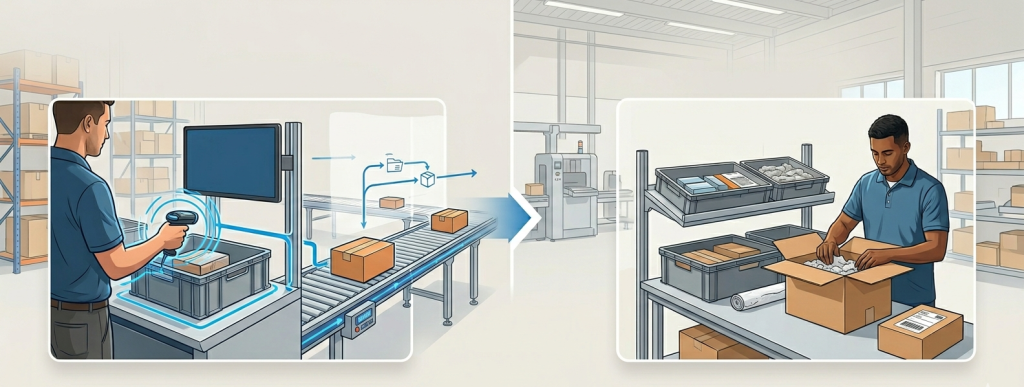
Induction is the moment an item enters a sortation system. A picker pulls the product from its shelf location, brings it to an induction station, and scans it. That scan does a lot: it verifies the item, checks it against the order, records its weight and dimensions, and fires a signal to the sortation system telling it exactly where this item needs to go.
If anything’s off wrong barcode, unexpected weight, damaged packaging it gets flagged right there, before it travels any further through the fulfillment center. That’s the whole point of the induction step. It’s a checkpoint, not just a handoff.
From there, the item moves along a conveyor into the sort system, which assigns it to the correct tote, chute, or order lane based on the WMS (warehouse management system) routing logic.

Pack-out: where orders become shipments
Once an inducted item reaches the right tote or order lane, pack-out begins. This is where a real person not a conveyor makes judgment calls.
The packer checks that every item in the tote matches the order. They pick the right box size, add void fill where needed, seal the carton, and apply the shipping label. It sounds straightforward, but getting this stage wrong is expensive: a mis-packed order means a return, a re-ship, and an unhappy customer.
The quality of pack-out depends directly on how accurate the induction step was. If an item was inducted into the wrong lane, the packer either catches the error which slows everything down or misses it, which means the customer gets the wrong thing. That connection between induction accuracy and pack-out output is something good pick and pack warehouse services take seriously.
Why this matters for ecommerce businesses
When you’re growing on Shopify, WooCommerce, or any other platform and volume starts outpacing what you can handle in-house, this is the process you’re outsourcing to a 3PL ecommerce fulfillment provider. You’re not just paying for storage space. You’re paying for a system where induction catches errors before pack-out, and pack-out ships orders correctly the first time.
For small and growing brands, that reliability is what separates a 3PL fulfillment solution that actually scales from one that just creates new problems at higher volume.
At 3PL Business, our New Jersey fulfillment center handles induction and pack-out for ecommerce sellers across Shopify, WooCommerce, and Amazon FBA channels. If you’re looking for a pick and pack fulfillment service that’s built around order accuracy not just throughput — get in touch with our team to talk through your requirements.
FAQs
What is induction in a warehouse?
Conceptually similar – both are platform-managed fulfilment. The key difference is FBT only covers TikTok Shop orders
What is the difference between induction picking and pack-out?
Induction picking is the upstream step items are scanned, verified, and fed into a sortation system. Pack-out is the downstream step items from the same order are gathered, boxed, labeled, and prepared for shipment. Induction accuracy directly determines pack-out accuracy: errors made at induction tend to surface as wrong-order shipments at pack-out.
How do 3PLs integrate with ecommerce platforms?
Most 3PL fulfillment solutions connect to ecommerce platforms via API or middleware integrations. When a customer places an order on Shopify or WooCommerce, the order data is pushed automatically to the 3PL’s WMS, which triggers picking, packing, and shipping. Tracking updates are then sent back to the store and the customer in real time.
Is pick and pack fulfillment right for small businesses?
Yes, pick and pack fulfillment services are well-suited for small and growing ecommerce businesses, particularly those shipping more than 50–100 orders per month. At that volume, the cost of doing it in-house (labor, space, packaging materials) typically exceeds the cost of outsourcing to a 3PL fulfillment center.